
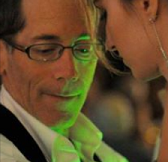
It’s obvious from this picture that Julio de Caro had a lot of female fans, perhaps a bit too many for his singer Héctor Farrell, who seems to feel a bit shy from all the attention.
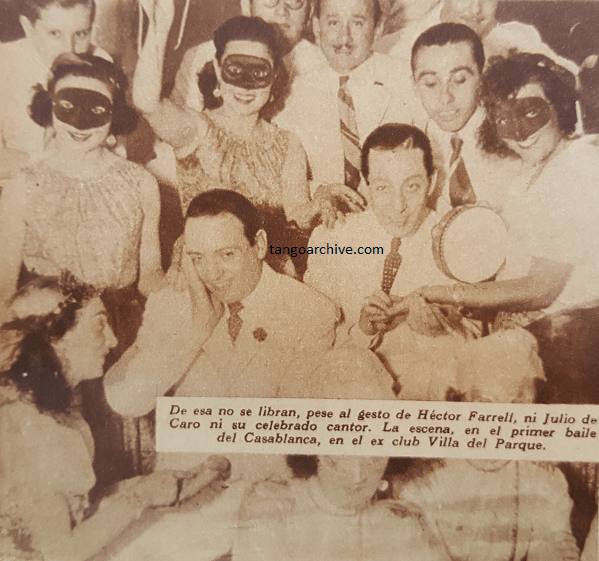
It’s obvious from this picture that Julio de Caro had a lot of female fans, perhaps a bit too many for his singer Héctor Farrell, who seems to feel a bit shy from all the attention.
Anyone still surprised why his music is so danceable?
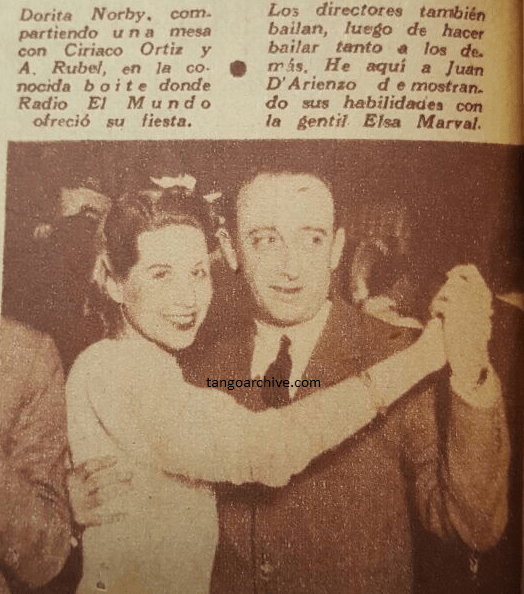
Here, three famous orchestra leaders are shown together in what seems a brotherly fashion, although even in the very companionable Argentine culture there must have been some sort of jealousy or rivalry among artists of this level. Jealousy or not, the caption says that the most famous orchestras of the moment were competing in front of ”a immense audience” in a contest on ”Radio Casino”. I wish I could listen to that now!

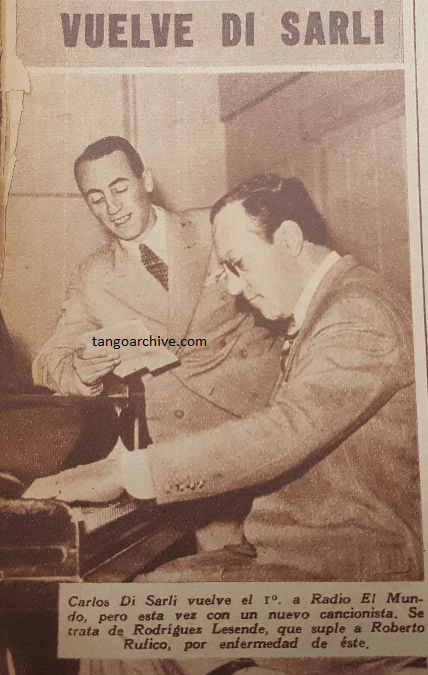
According to this image, a certain Antonio Rodríguez Lesende replaced Roberto Rufino for a while as Di Sarli’s singer because of illness. And indeed, there is (just) one 1940 recording, ”Milonga del Centenario” with that unfamiliar voice, or at least unfamiliar to most dancers nowadays.
However, interestingly, Rodríguez Lesende was actually a famous artist back then, and Troilo’s first choice to become the emblematic singer of his orchestra rather than Francisco Fiorentino. Rodríguez Lesende declined the job, because he didn’t want to work nights (source: Michael Lavocah, Tango Masters: Aníbal Troilo) and seemed to have been overloaded with work in general. Now, nobody remembers his name.
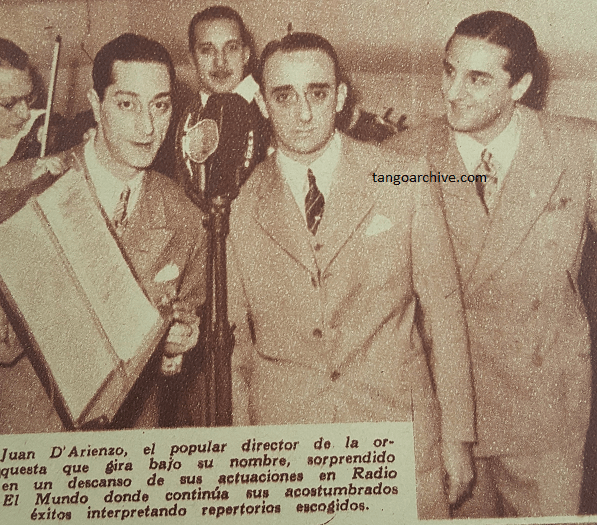
After his orchestra imploded with everyone leaving him in early 1940, D’Arienzo had to look not only for a new team of musicians, but also for a new singer. Other than some people may think nowadays, the first singer who joined him was Alberto Reynal, who has a ”tough guy” voice similar to Echagüe, and not Hector Mauré, who joined later. In fact, also the lesser-known Carlos Casares arrived earlier and left us with the currently popular recording ”Rie payaso” and another song called ”Yo también”. Both Reynal (left) and Casares (right) are shown on this picture.
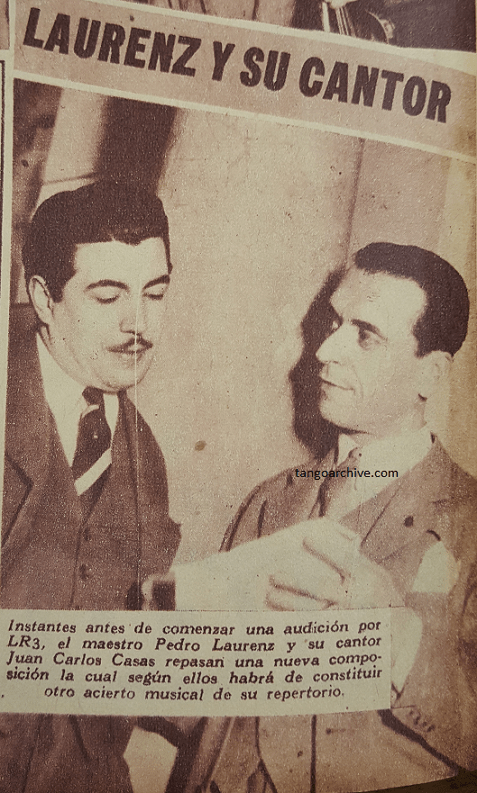
Here is a rare picture of Pedro Laurenz (on the right) together with his late 1930s star singer Juan Carlos Casas. Actually, I don’t remember ever having seen a single picture of this duo on the internet. I love Casas’ voice, beautifully embedded in the energetical, high-spirited Laurenz style of those years, for me the peak of his career.
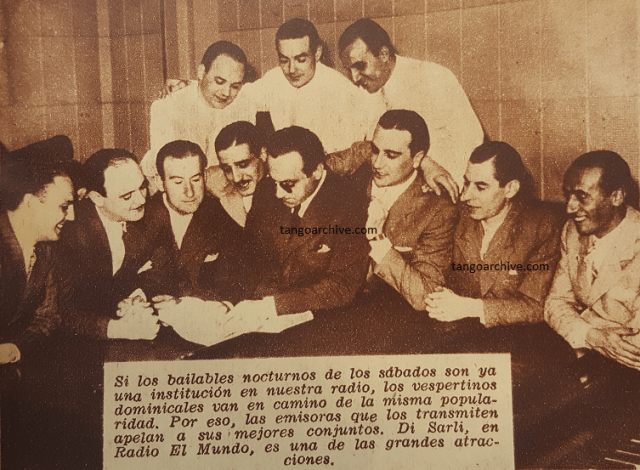
Yes, these are the men who brought you some of the best dance songs imaginable, for example Di Sarli’s rhythmical instrumentals from around the year 1940, like El Retirao or Viviani, and of course the greatest hits with ”the kid” Roberto Rufino, who, by the way, seems to be absent on this picture. As a DJ, I play, or better put, use that kind of essential music with great enthusiasm, and every man on this picture is a hero for me. And on the right, a hero with a quite a suntan!
That may be surprising to some: Sassone in 1940 and Alberto Amor (think of Biagi) as his singer? In the best years of tango as dance music, the early 40s, there were so many active orchestras that haven’t left us a single recording, which means we miss out on a lot of interesting combinations of tango bands and singers, or simply an ”earlier” sound of orchestras that aren’t famous for dance music nowadays. Florindo Sassone only started recording in the late 1940s: had he begun doing that earlier on, he could have been more popular nowadays.

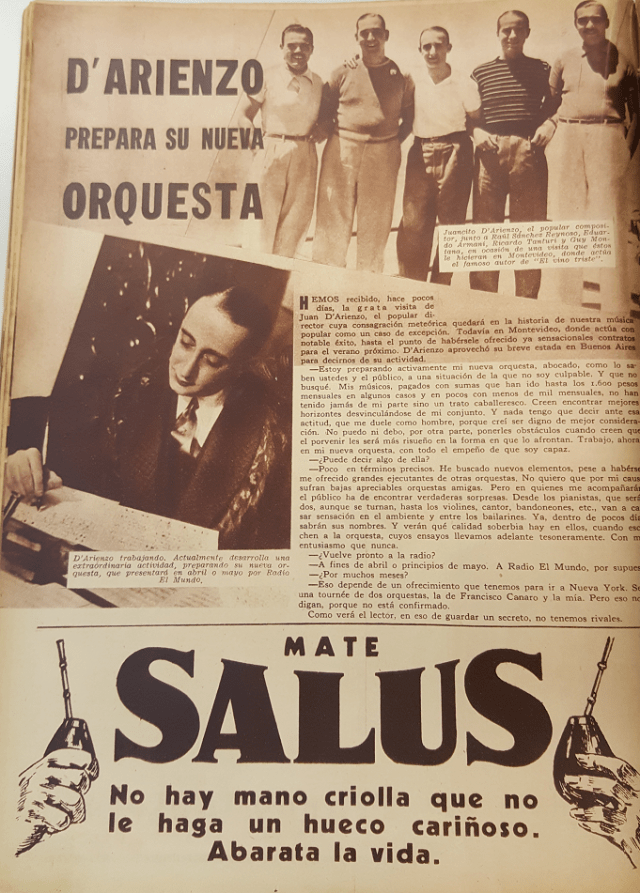
After D’Arienzo was abandoned by his entire orchestra and his singer Alberto Echagüe in early 1940, he wasn’t exactly thinking about giving up on the tango business. After a few months of preparation and hard work, the popular King of the Beat returned to the stage as the new orchestra leader of Hector Varela’s band and thus, D’Arienzo’s 1940s sound was born. The following article features that preparation, and interestingly, D’Arienzo talks about the breakup with his previous musicians, something he doesn’t understand at all. Summary: ”It’s all their fault, I paid them a lot of money, I really didn’t do anything wrong and I wish they have treated ME more gently, but I won’t obstruct them because I prefer working on my own orchestra instead…”
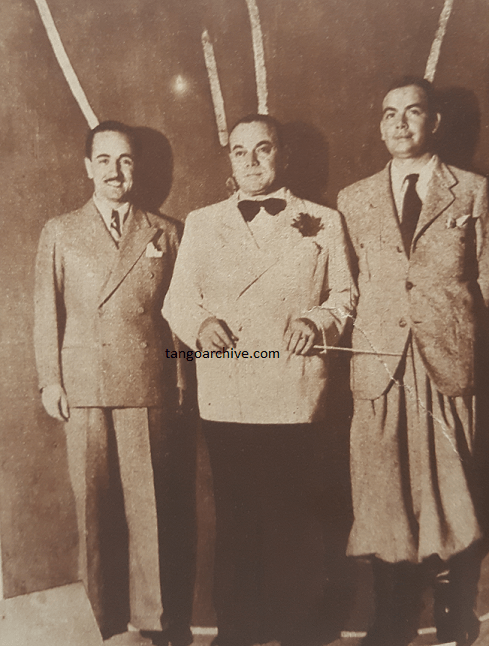
In 1939, jealous Roberto Maida left Francisco Canaro’s orchestra when the latter accepted two more singers into his orchestra: Ernesto Famá, who had already been a partner before, and a new face, Francisco Amor. These two men would mark the beginning of Canaro’s 1940s sound. Here there are shown together (from left to right: Fama, Canaro, Amor) on tour in Montevideo, Uruguay.
Michael Krugman, † Dec. 2016
 Tango Archive