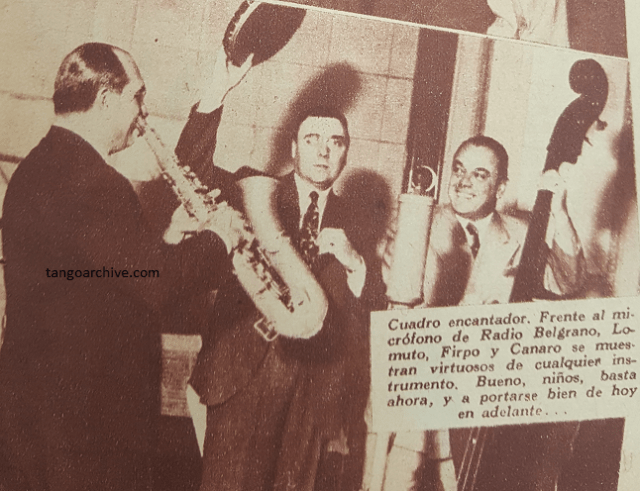
Lomuto, Firpo, Canaro, experts of ALL instruments?!

This frivolous scene shows us a jazzy Lomuto mastering the saxophone, Firpo shaking it with his tambourine and a confident Canaro rocking it on a double bass. That must have sounded great, right? Well, these guys were surely talented, but perhaps even in their case, perhaps we should take this picture with a grain of salt… even the caption tells these kids to finally beháve for a change!

canaro firpo lomuto instruments

Posted in Uncategorized | Leave a comment

Canaro’s favourite composition

There are many orchestras with many great recordings, and sometimes a few stand out (that is, at least, when judging from their extreme popularity in our present-day milongas), but without sources, it would be hard to determine what songs the orchestra leaders themselves preferred.

In the little text below, Francisco Canaro is asked about his favourite own composition. Perhaps to your surprise, ”Pirincho” (his nickname) mentions a rare tango, Sentimiento gaucho, he himself recorded several times, for instance in 1930, 1940 and 1951, yet is probably mostly known to today’s audience as a late D’Arienzo track. In fact, when hanging around at Club Gricel, Buenos Aires in August last year, I heard someone announce that Osvaldo Ramos, D’Arienzo’s last singer, had just died, and as far as I can remember, the DJ played exactly this tango.

In any case, in this little interview Canaro himself explains the inspiration, the motive behind this old tango:
”The streets. The old Paseo Colón, where that bar, called Sentimiento gaucho, used to be located, and in fact it still is. One day I randomly ended up there, in that bar, and a young, ragged man was desperate to share his story with me. Believe it or not, but I listened to all of it, and deeply impressed, I sat down at my piano, and with great ease this tango was born, which won the first prize in the Gran Splendid contest, in the year 1923.”

Sentimiento gaucho is the apparently true tale of a gaucho betrayed by the love of his life. Interestingly enough, the lyrics begin from the perspective of an anonymous narrator, supposedly Canaro, who enters an old bar and finds a poor drunkard, who then confesses his story to him. The article below, likewise, ends like this (first line of the lyric): ”And Francisco Canaro thinks back to that ‘old bar on Paseo Colón, the home of those who have lost all hope…”’

canaro fav song.png

Posted in Uncategorized | 2 Comments

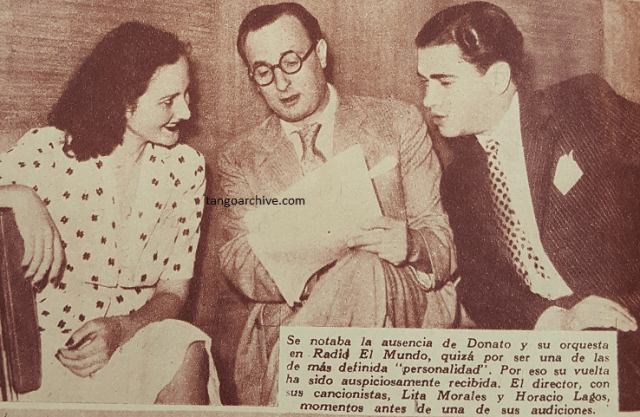
Donato with Lita Morales and Horacio Lagos

Today’s picture shows us Edgardo Donato presumably discussing a song with two of his famous singers, Lita Morales and Horacio Lagos, who were also a married couple. There is a lot of uncertainty and speculation about their relationship and Romeo Gavio (Donato’s third singer), but we will keep looking for clues about this mysterious history.

donato lagos morales

Posted in Uncategorized | Leave a comment

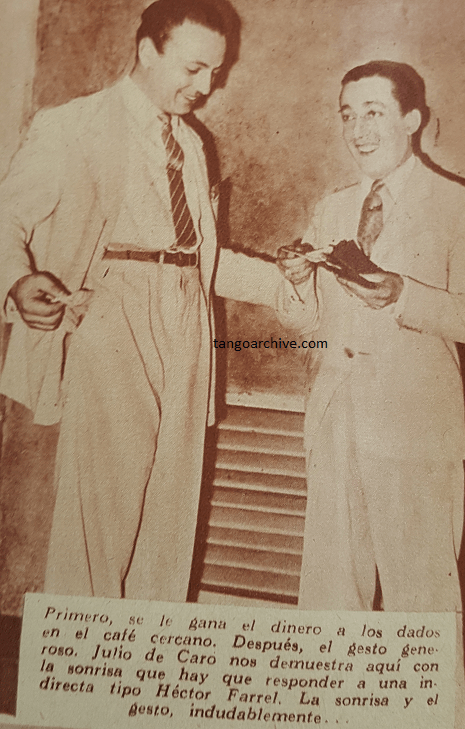
Hey you! Gotta pay your singer!

We’ve seen orchestra leaders with tangueras in their arms, or simply hanging around with cute groupies, or celebrating their birthdays, joking around in a bar, sliding down the stairs, just standing there being handsome with a cigarette, and the list goes on…

…. so, not a bad life at all. However, sometimes it was also necessary to pay up, and nobody really likes to fork out their earnings, do they? Well, maybe Julio de Caro was an exception, because on this picture he is seen pulling out his wallet with a big smile, while his singer Héctor Farrel points out his empty pockets. A man’s gotta eat, or play poker in a nearby cafe, but I guess his singing was worth the expense.

Posted in Uncategorized | Leave a comment

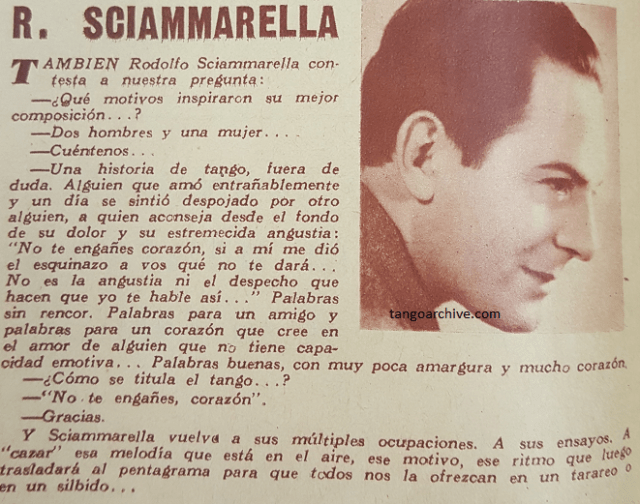
A song explained (No te engañes corazón)

Often, it’s impossible to find out about the original meaning or context of a tango song and lyric. We are many decades too late to ask the authors about it. However, at least in the picture below Rodolfo Sciammarella, a composer of a few important songs, is asked about his favourite (own) composition.

Sciammarella highlights ”No te engañes corazón”, a popular dance track nowadays, and goes on to explain the meaning of that song. I always understood it in a different way, a man trying to console his own heart, but the author takes a different view. Soon, I hope to present you an adapted translation on one of my other blogs.

-”What motives inspired your best composition?”
S: ”Two men and a woman…”
-”Tell us”…
S: ”A typical tango story, no doubt. Someone who loved deeply, one day ends up deprived of his love by another man, yet gives him some important advice, from the bottom of his sorrow and his extreme sadness [quote from the lyric]:
‘Don’t let your heart be deceived, if she dumped me like this, will it be any different for you?’
‘Neither sadness nor spite cause me to talk to you this way….’
Words without rancour. Words for a friend, and words for a heart which believes in the love for someone who has no emotional capacity… good, heartfelt words, with almost no bitterness.”
-What’s the title of that tango?
S: ”No te engañes, corazón”. [Heart, don’t be deceived/Heart, don’t deceive yourself]
-Thank you.
And Sciammarella goes back to work. To his rehearsals. Or to catch that melody he feels in the air, a motive, some rhythm that he will write down as music so that all of us may hum or whistle it.

sciammarella no te enganes.png

Posted in Uncategorized | Leave a comment

Roberto Flores and his own orchestra

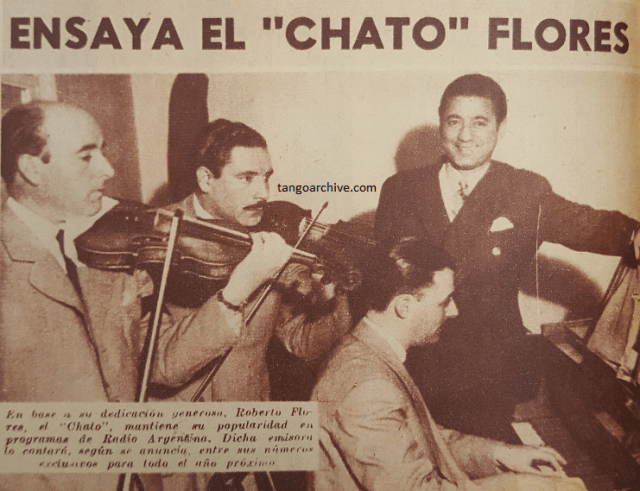
This picture shows gone-soloist singer Roberto Flores with his own musicians after leaving Enrique Rodríguez in early 1940. Flores went on to tour several Latin American countries, kept working as a soloist in Argentina with reasonable success and ultimately ended up in Medellín, Colombia, a city known for its tango enthusiasts, where he lived until his death.

There are a few recordings that allow you to imagine what this orchestra sounded like. Quite nice, as far as I am concerned. Even though Flores went solo, in this case his team still made dance music, where the role of the singer is limited. Usually, famous singers would sing an entire song, which is not dance music, but tango canción, like the work of Carlos Gardel.

roberto flores.png

Posted in Uncategorized | Leave a comment

Fresedo playing bandoneon, Ruiz and Mayel

This photo shows Osvaldo Fresedo playing bandoneon, which is the instrument he started his (very long) career as a musician with, as you can hear in this recording. Later, it seems he instead focused on directing his orchestra. The caption mentions Fresedo sometimes took up his instrument again. He is being witnessed by his singers Ricardo Ruiz (right) and Carlos Mayel (left), previously shown in an earlier post together with the orchestra.

fresedo bandoneon ruiz mayel.png

Posted in Uncategorized | Leave a comment

José Garcia the Dancer (and his band too)

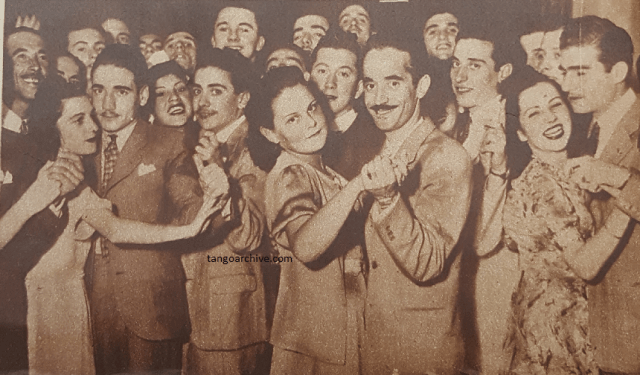
Among the tango orchestras, José Garcia is a bit of a sad case: it has quite a beautiful, refined, romantic sound, right from the heart of the Golden Age, yet it seems truly impopular with dancers nowadays. Recently, I’ve come to appreciate it much more, but I am like a voice in the wilderness.

The picture below suggests this wasn’t the case in the glorious days of the Golden Age, because the orchestra members are shown surrounded by fans, by dancers, and especially closely surrounded by female dancers, if you get what I mean. Yes, it seems as if these musicians knew how to make a tanguera’s heart happy, also on the dance floor. By the way, mister Garcia himself is the one with a somewhat less close embrace at the centre of the picture.

jose garcia dancing.png

Posted in Uncategorized | Leave a comment

Troilo and Fiorentino

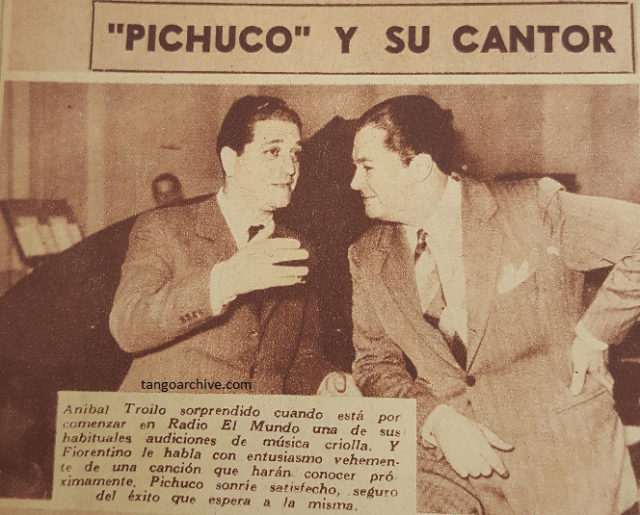
Troilo’s nickname was “Pichuco” and this picture shows him with his singer “Fiore”, who was apparently talking to him about one of their latest hits, just before the orchestra starts playing in a radio session.

troilo fiorentino 2.png

Posted in Uncategorized | Leave a comment

Sassone and Teófilo Ibáñez

Ever heard of this combination? Probably not. There are no Google search results at all.

Florindo Sassone was already active with his orchestra during the peak of the Golden Age of tango, but sadly, he left no recordings in that key era. We’ve shown earlier proof of his activities on this website, with Alberto Amor as a singer.

In this case, judging from the image below, Sassone worked together with singer Teófilo Ibáñez at some point in the early 1940s. Ibáñez, with his rough voice, is most famous for being Biagi’s first singer, in 1938 and 1939, after a career as a typical refrain singer in the ”Guardia Vieja” tango orchestras of the early 30s, such as Orquesta Típica Porteña.

Sassone is the man with the somewhat light suit and regular glasses in the middle of the picture, and Ibáñez has a dark suit, standing on the right.

sassone ibanez

Posted in Uncategorized | Leave a comment